
Trapping with Feeling
What is trapping?
Trapping is to hold, “something tightly, usually a body part so it cannot move or be freed.”
Now, what is Trapping with Feeling? And how is trapping with feeling different from just trapping? Before we can answer that, we need to know what trapping is from the perspective of Jun Fan Jeet Kune Do.
Trapping in Jun Fan Jeet Kune Do can trace its roots back to Wing Chun Gung Fu. Trapping is a response to your opponent so that you can land your strike by countering his hand or foot. It can be mechanical, based on a set of scenarios or a spontaneous reaction to the overchanging energy from your opponent. In order to effectively trap, you must be able to feel your opponent’s energy. The opponent will give you different types of energy and you must be able to adapt to what you are given. It is not about what you see but what you feel!
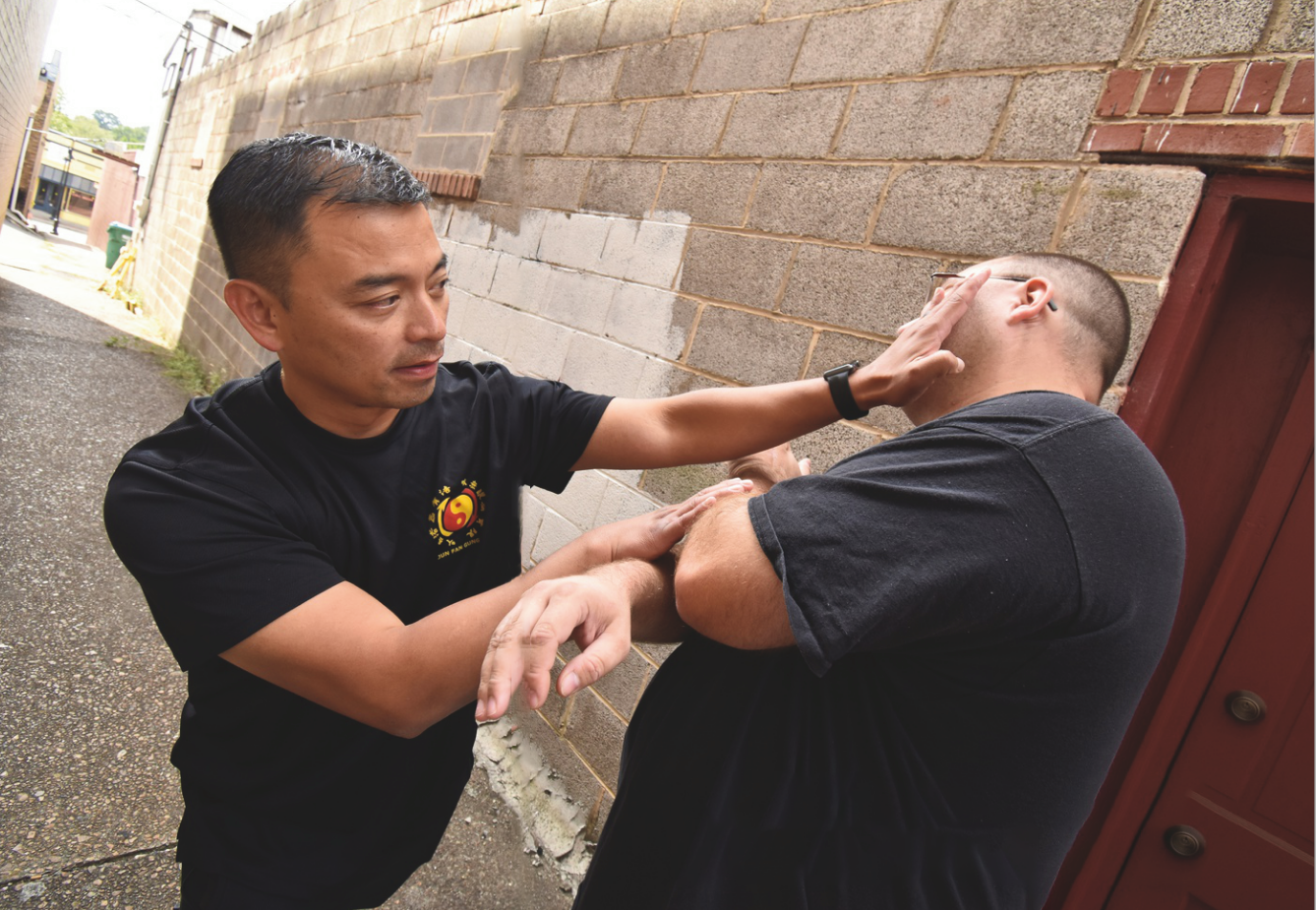 Most people practice drills where your opponent throws a certain strike and you counter with your own strikes. But what happens if their strike is not what you anticipated? What happens after the initial strike and your hands touch? The person can react very differently than a prior experience. At such a close range, you do not have time to think about what you will do. Instead, you must feel, adapt, and react to what your opponent gives you! In this instance, you think, not feel.
Sensitivity through Practice
In the beginning of a fight, you and your opponent are still learning about each other while trying to stay at a safe distance from one another. In this long range, it is easy to see your entire opponent in full form—from his feet, legs, arms, and hands. But when you engage, as one of you strikes and bridges that gap or distance, then this is no longer the case. Once you close the distance between your opponent, you also lose your full sight of your opponent. It’s normal to react to what you see, but when you are so close to your opponent that you cannot see his arms or hands, then you must resort to feeling your opponent’s energy. Your eyes become your hands.
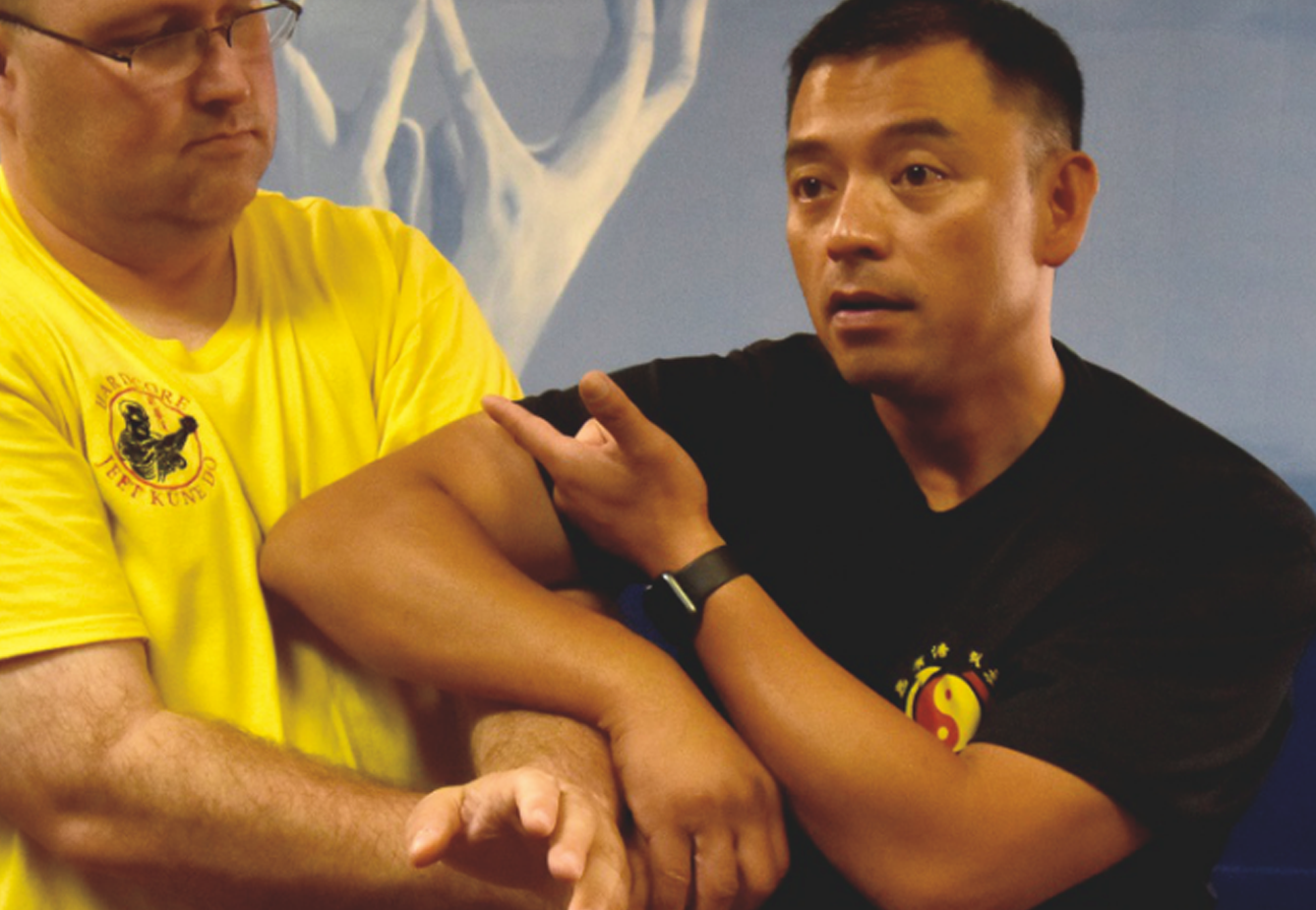
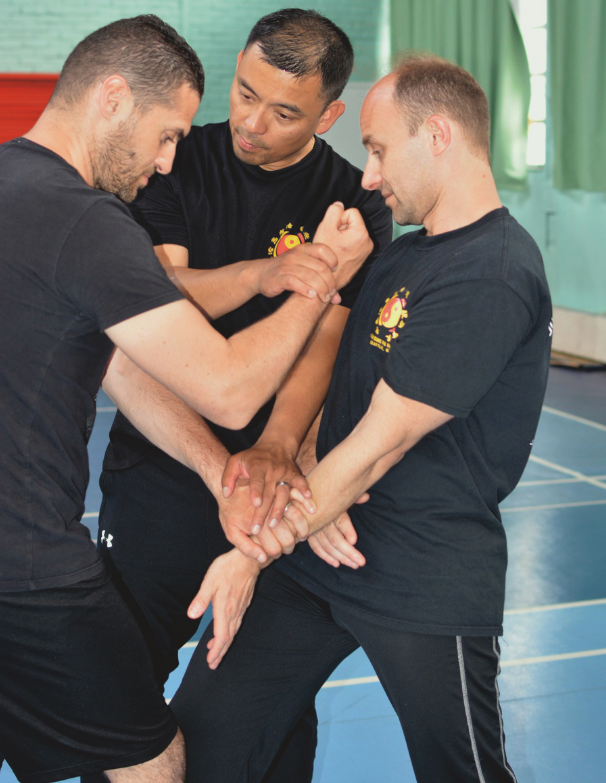 The goal is always to hit your opponent either with a kick or punch. And hit them good! What do you do if your target blocks your strike? You either immobilize his hand or foot by trapping or checking it with your hand or foot. For the sake of this article, we say that trapping is done only by your hand. But it is not a forceful slap or check of his hand. Instead, it is soft and yet firm when you make that initial contact, moving your opponent’s hand and immobilizing it until you make contact with your target.
How do you train and teach yourself to Trap with Feeling?
This sensitivity can only be achieved through practice, which entails a specific exercise that is unique to Wing Chun Gung Fu. Hours and hours of specific practice to develop this sensitivity can only be done through Chi Sao. You practice Chi Sao until your shoulders ache and it feels like they want to fall off. But you keep going and going and then go some more! With Chi Sao you must practice soft, not hard. When it’s hard it becomes wrestling and you lose the essence of Chi Sao. You have to stay soft in order to feel and then redirect your opponent’s energy.
Wing Chun was founded by a woman, a Shaolin nun less than one hundred pounds. She had to redirect energy and not meet force with force. Most people, if not all, were much bigger than her, so she had to feel and adapt.
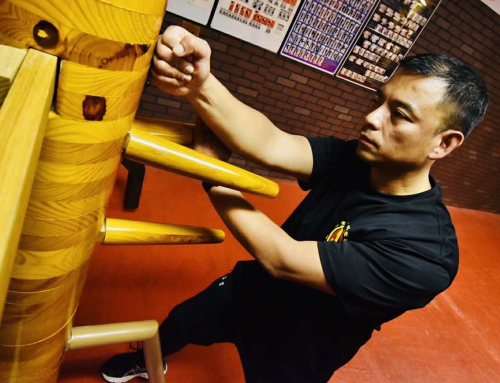
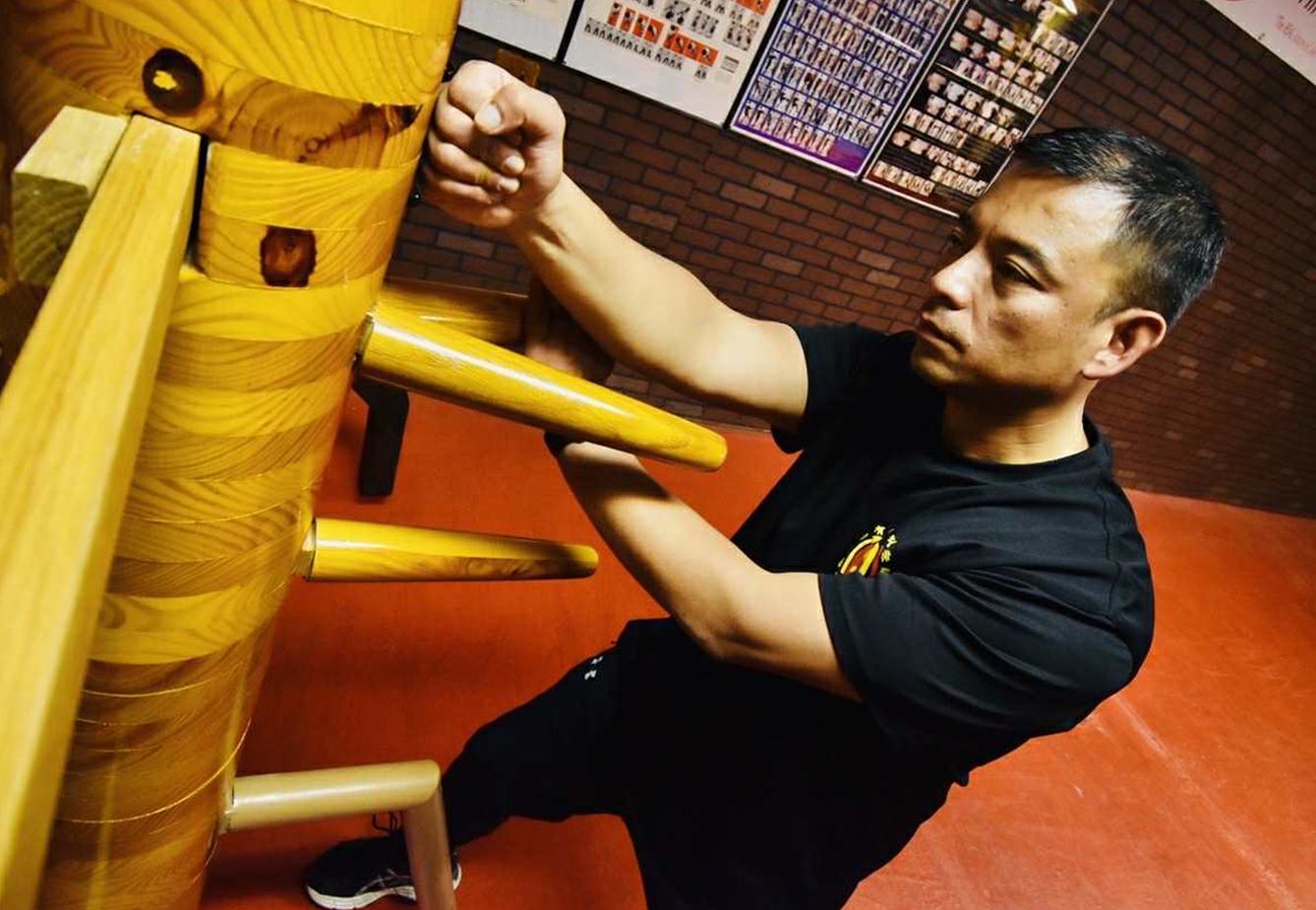
…moving your opponent’s hand and immobilizing it..
Of course, there are limitations to Chi Sao as it is very difficult to do Chi Sao with someone who is much bigger and stronger than you. It is not impossible to do Chi Sao against a much larger opponent, just more difficult! It takes time and patience to develop as well as cooperation between both participants.
 Sigung Bruce saw this, and when he was in Los Angeles where he had much larger and stronger students such as Kareem Abdul-Jabbar or Bob Bremer, it was during this experience he realized Chi Sao would be mostly ineffective against them and take too long to develop. For this, he emphasized less in Chi Sao and more on bridging the gap against these larger opponents. It was not that Chi Sao was no longer important, but his main focus shifted towards mobility and bridging that gap against these taller and larger opponents.
Sigung Bruce was already proficient in Chi Sao and the sensitivity it develops, especially when trapping, so he decided to focus more on mobility. Feeling and being sensitive to your opponent’s energy, no matter how big, is still very important when trapping.
It is this constant practice of Chi Sao—always touching and feeling your opponent—that can result in this feeling when trapping. You end up being more mechanical if your mind is here when you do this, or if it is here then you do this. But that is not what you are saying to yourself in the moment. Instead, you feel and your hands just move no matter what your opponent gives you.
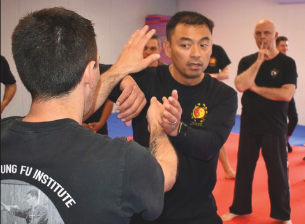 During my time at the Jun Fan Gung Fu Institute of Seattle, we did a lot of Chi Sao. Sifu Taky said to always be light, never hard. He said your energy always came from your center of your navel. Sometimes, he would walk around and slap our stomachs to remind us of this.
We also had another Sifu—his name was Chris Sato, whom I just recently learned is alive and doing well. None of us have heard from Sifu Chris for some time since we left the grocery store in 2001 as it seemed he just disappeared from the face of the earth!
Sifu Chris focused on Chi Sao! From 1991 to 2001, he had a 3-hour Saturday workout that was by invitation only, where we only focused on three things: Chi Sao, one-inch punch, or developing power when you were close to your opponent, and of course, full contact sparring with people from our class and others he would invite from the street to test us.
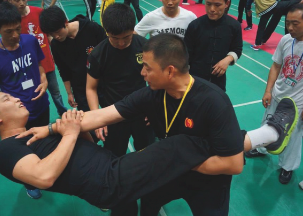 Sifu Chris was a former black belt in Judo and one injury away from the Olympics. But for a short period of time in his life, he was homeless and lived out in the street. He said that at times he would wake up to someone trying to steal his things, so he would have to defend himself on a daily basis. And he always told us, “Guys, this stuff works, it really does.”
Because he had to use it almost every day! And Chi Sao was important to him because at times you would be close to your opponent and needed to react based on the energy he gave you. So, on our Saturday mornings, we began and ended class with Chi Sao and in between our sparring breaks.
We would form two lines and do Chi Sao with the person across from us for a few minutes, then rotate after a few minutes to a different opponent, until we did Chi Sao with everyone in class. We had people of different sizes and strengths, but that did not matter as we did Chi Sao with everyone in class regardless of their size. Since we had limited time and were in a hurry to develop as a group, we were able to develop our sensitivity the old-fashioned way, just as Sifu Chris wanted.
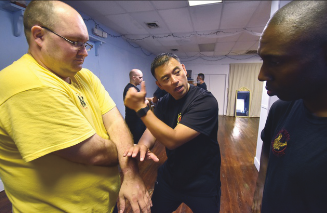 Our shoulders were burning and our arms felt like falling off. We were not concerned with their size but only on dealing with their unique energy. Sifu Chris drew his knowledge from Sifu Taky and his uncle, Sensei Fred Sato. Sensei Fred Sato was one of Sigung Bruce’s good friends while in Seattle and also taught him Judo. It is a small world after all.
Trapping with Feeling does not mean that your trapping is mechanical, but instead means that you are always feeling for the path of least resistance—no matter the energy your opponent gives you. You are always feeling and adapting to your opponent regardless of how big or strong they are because you are reacting while using their own energy against them.
…it is never strength agains strength…
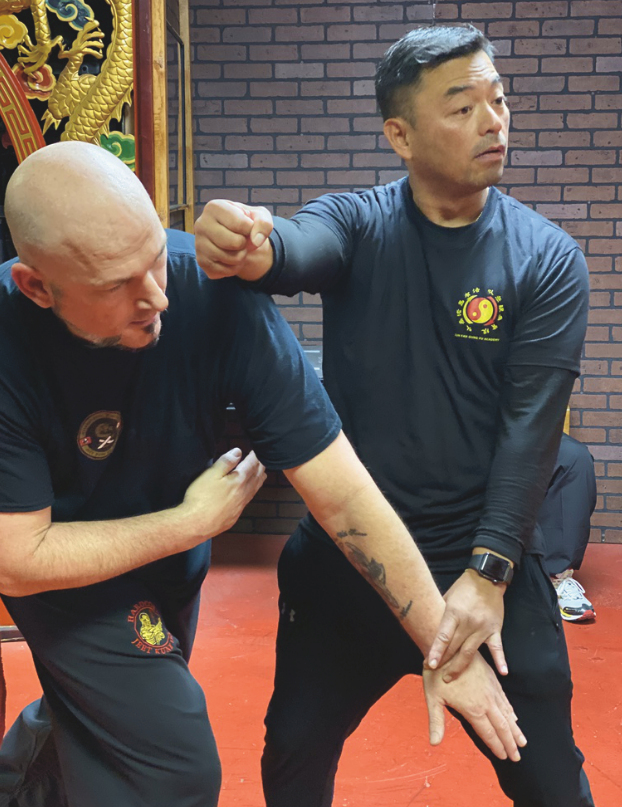 You are flowing from one movement or trapping to the next without thinking but feeling! You are never hard but soft and firm when you do the trap or strike. It is never strength against strength; instead, it is redirecting energy in your favor.
This is Trapping with Feeling!
Share this article
Follow us
Related Posts
STAY IN THE LOOP
Subscribe to our free newsletter.
There’s no better source for the Totality of Jeet Kune Do than Bruce Lee’s best friend and highest-ranking student, Sifu Taky Kimura. In this interview with Taky’s protégé, Sifu Abe Santos, learn the true history of Jeet Kune Do. What do you think is the biggest misconception about what you teach?The main misconception is that
Through the years I have heard the term … Jun Fan Jeet Kune Do. In this article, we will discuss my view of the literal meaning of Jun Fan Jeet Kune Do, its creation and evolution, the difference between Jeet Kune Do and Jun Fan Gung Fu, and the true meaning of Jun Fan Jeet
Today we’d like to introduce you to Abe Santos. Thanks for sharing your story with us Abe. So, let’s start at the beginning and we can move on from there. I am a senior instructor at the Jun Fan Gung Fu Institute of Seattle. I have been a student and friend of Sifu Taky Kimura